
Protein-Protein Interaction Techniques
We use multiple techniques to study protein-protein interactions. These assays detect and characterise physical or functional interactions allowing us to increase understanding of cellular pathways, regulatory mechanisms and disease processes.
Our Services:
FRET
Fluorescence Resonance Energy Transfer (FRET) relies on distance-dependant (1-10 nm) energy transfer between two dye molecules. FRET assays using binding partners labelled with donor and acceptor dyes can be used to assess the impact of test agents on protein-protein interactions.
HTRF assay example:
- The HTRF assay was used to detect phosphorylation of an endogenous protein.
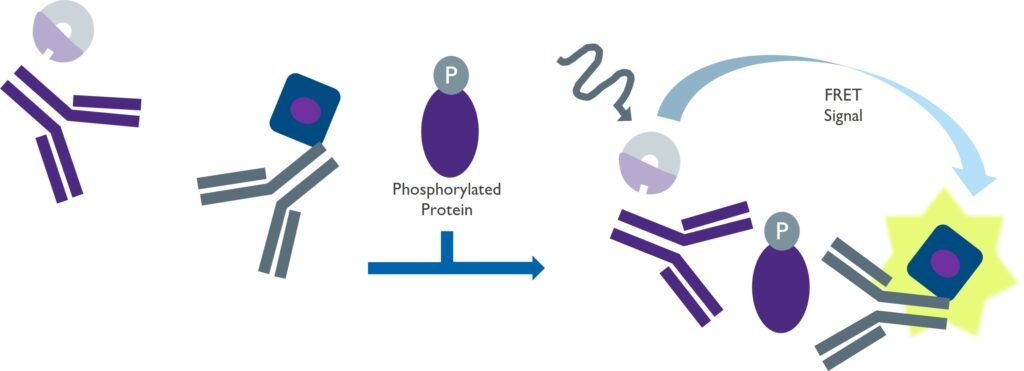
- To do this two 2 different specific antibodies, one labelled with Eu3+-Cryptate (donor) and the second with d2 (acceptor), were used.
- When the dyes are in close proximity, the excitation of the donor with a light source (620 nm) triggers FRET (Fluorescence Resonance Energy Transfer) towards the acceptor, which in turn fluoresces at a 665 nm.
- The specific signal modulates positively in proportion to levels of the phosphorylated protein.
- The aim of this experiment was to validate the suitability of the kit to investigate changes in levels of the phosphorylated protein in response to client test agents, as well as a known +ve control.
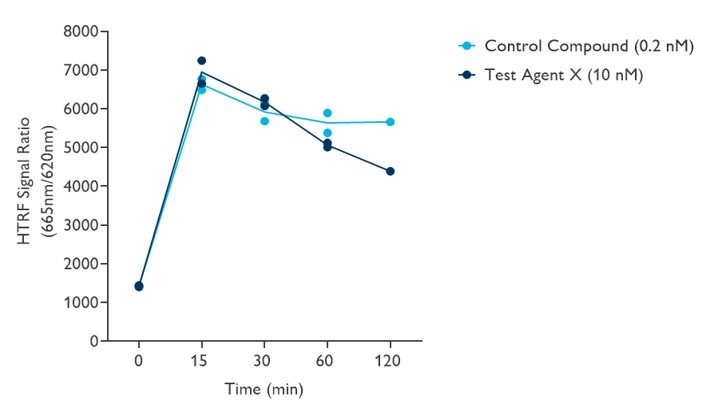
- Parameters that require optimisation were investigated and included cell density per well, and test agent treatment time.
HTRF data, showing the time dependent increase in the HTRF signal ratio indicative of the level of phosphorylated protein within the cells. This is following treatment with either Test Agent X (10 nM) or Control Compound (0.2 nM).
Fluorescence polarisation
Fluorescence polarisation is used to measure the interaction of two molecules in solution: a fluorescently labelled tracer and a larger unlabelled binding partner. Interaction with the binding partner slows the molecular tumbling of the labelled tracer and changes the depolarisation of plane-polarised incident light. We have experience of using fluorescence polarisation assays to detect small molecule-mediated inhibition of protein binding.
Find out more about others services offered by our in vitro team:
Our in vitro team input at all stages of the drug discovery pipeline, feeding into the integrated approach of RxCelerate:
|